Panhandle Parables
2025-Present
Panhandle Parables turns to the landscape and cultural memory of the Florida Panhandle, where Jonathan Yubi was raised. The paintings present staged scenes populated by imagined environments drawn from a Southern imagination. Rather than functioning as documentary images, these works operate as allegories—quiet narratives that explore how identity, labor, and migration are shaped by place. The series treats the Panhandle as a symbolic terrain where personal history intersects with broader American mythologies, using the language of figurative painting to construct parables about belonging, displacement, and regional memory.

La Marcha de Octubre, 2025
oil on canvas
67 x 114 in (170 x 295 cm)
La Marcha de Octubre reimagines the Women’s March on Versailles (1789) within a modern warehouse, centering the strength of immigrant women laborers. A group of workers gathers in solidarity, their orange shirts evoking both visibility and unity. The central figure holds a document marked PL 2023 Chapter 10, referencing New Jersey’s law protecting temporary workers’ rights. Name tags link three women to historic Latina labor activists, bridging past and present struggles. Surrounding shelves bear corporate packages, a reminder of the industries dependent on precarious labor. With brooms and mops raised as symbols of resistance, the women stand poised for collective action.
First commissioned by Monuments to Migration and Labor, a project of Rutgers University in collaboration with coLAB Arts, Newest Americans, and Noyes Museum of Art of Stockton University, with funding from the Mellon Foundation

Absalom Oh Absalom, 2025
oil on canvas
55 x 55 in (140 x 140 cm)
Inspired by William Faulkner’s Absalom, Absalom! Which also drew inspiration from the Death of King David’s son, Absalom. The novel is set in the Civil War-era South. The painting draws on my experiences growing up in the American South.
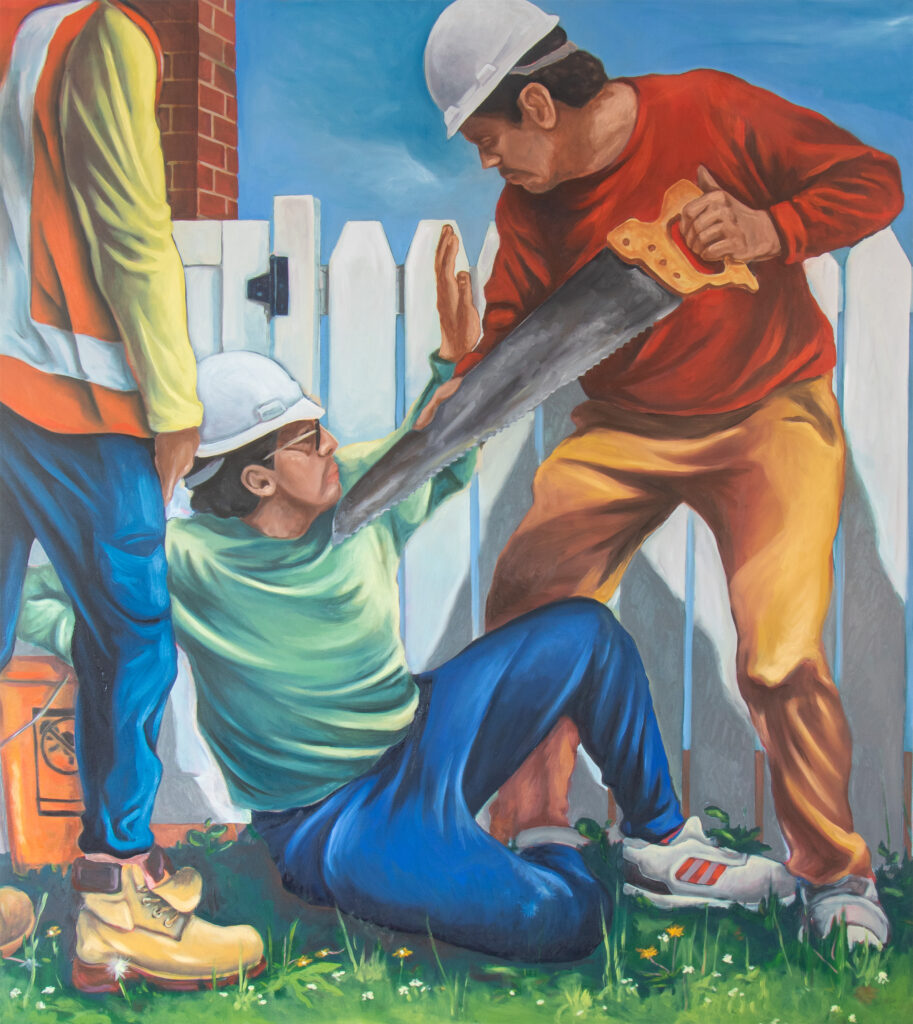
Nuestro primo Héctor y la muerte de Abel, 2025
oil on canvas
56 x 50 in (142 x 127 cm)
Nuestro primo Héctor y la muerte de Abel is a Genesis story about Cain and Abel. As kids, we’d drive 90 minutes west to Panama City Beach to visit family for the holidays. Thanksgiving was always the most notable. Everyone would bring a small dish to Hector’s place. He was my stepdad’s nephew. He would present a kingly banquet, his offering to the family. It wasn’t until I was a few years older and living away from home for college that I thought back on those days. To Hector, a man in his early 50’s, and his long-time roommate, Luther.
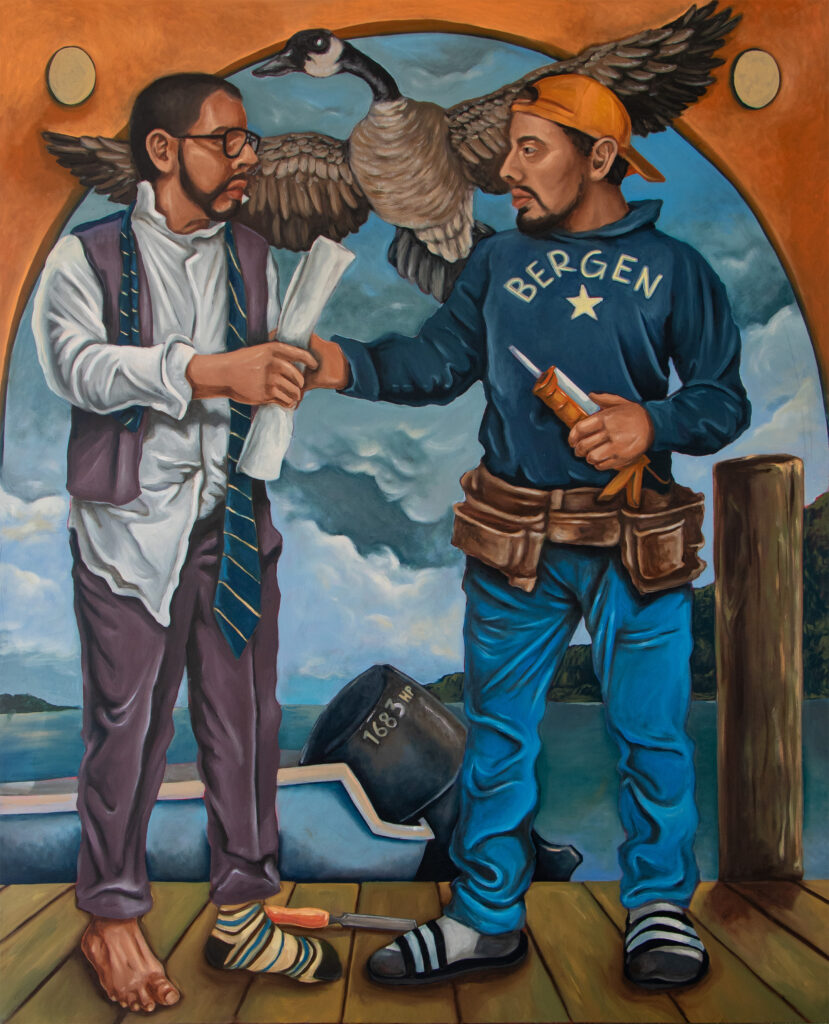
Los Dos Bergens, 2025
oil on canvas
47 x 57 in (119 x 145 cm)
Referencing Kahlo’s use of mirrored figures in Las Dos Fridas as carriers of shared identity rather than opposition, Los Dos Bergens positions Bergen County as a site shaped by ongoing movement from the Global South and by a deep history of labor activism.
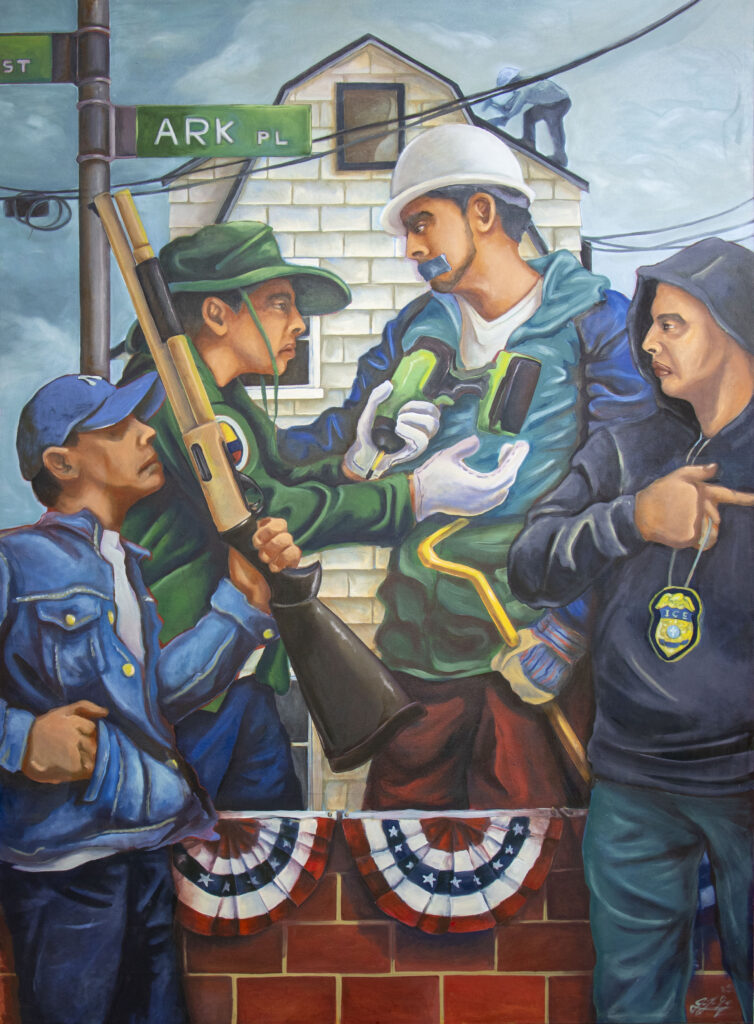
Deliver the Keys to Fred’s Residence, 2025
oil on canvas
60 x 44 in (152 x 112 cm)
Deliver the Keys to Freds Residence depicts six men: a pair of immigration agents on the foreside of a brick wall adorned in bunting, two workers behind said brick wall; one with painters tape covering his mouth, the other handing off an electric drill, one worker on the roof of a Dutch Colonial suburban home, and a final man lurking in the shadows of an attic, in a hooded white robe. The composition references Perugino’s Delivery of the Keys, with Perugino’s central building replaced by a stylized Dutch Colonial home. It’s somewhere between common knowledge and a forgotten family secret that Fred Trump (Donald Trump’s father) was arrested during a Klan rally in New York City in 1927. Fred’s story is no blip in the collective American past.
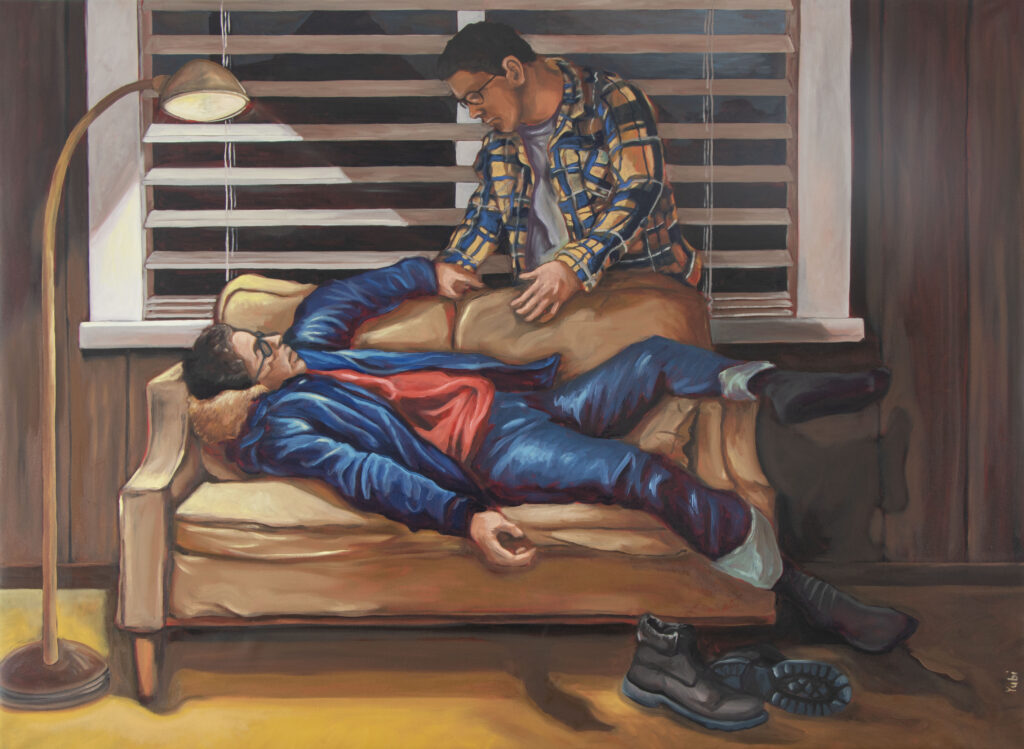
The Annunciation, 2026
oil on canvas
44 x 60 inches (112 x 152 cm)
The Annunciation reconfigures the biblical scene through self-portraiture, occupying the roles of both the Virgin Mary and the angel, and transforming revelation into an internal reckoning rather than a divine interruption. The reclining body appears exhausted and disheveled, boots scattered on the floor, while the standing figure leans in with measured gravity.
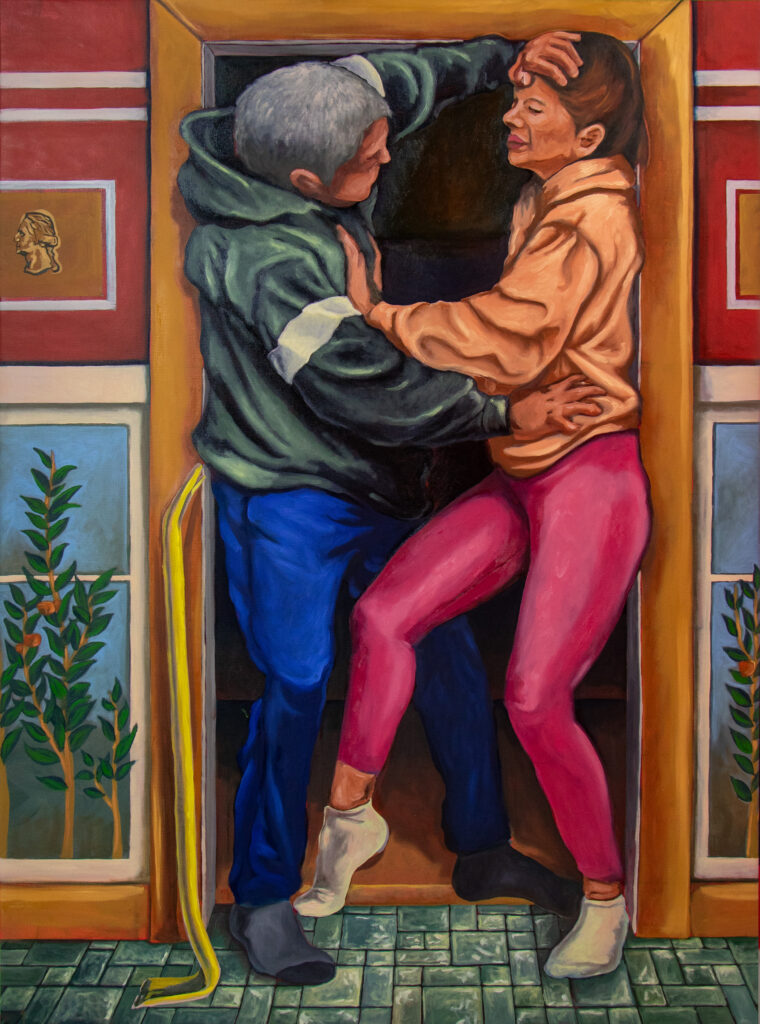
The Labors of a Sabine, 2026
oil on canvas
60 x 44 inches (152 x 112 cm)
Drawing from the Abduction of the Sabine Women, The Labors of a Sabine collapses antiquity into the present to consider how nations are formed through coercion and how labor exploitation is often gendered. During my time working with the New Jersey Monuments to Migration and Labor (NJ MML), a series of community dialogues revealed recurring accounts of physical and sexual exploitation experienced by temporary workers, many of them undocumented women. These testimonies inform the painting’s parable-like structure, connecting an ancient founding myth to contemporary systems in which vulnerable laborers are incorporated into economic life under conditions of imbalance and coercion.